Showing posts with label MuseItUp publishing. Show all posts

Sunday, 22 June 2014

H is for Historical Fiction - favourites


The following list is of historical fiction chosen at random from my bookshelves. Each of them have one thing in common – in future, I will read them again.


It would be interesting to know if anyone else treasures a book on my list.


Kane and Abel by Jeffrey Archer

The Greatest Knight by Elizabeth Chadwick

The Last Runaway by Tracy Chevalier

Sara Dane by Catherine Cookson

Sharpe (series) Bernard Cornwell

The Red Kimono by Christina Courtenay

The Red Tent by Anita Diamant

The Nightingale Sisters by Donna Douglas

Call Nurse Mille by Jean Fullerton

Angelique (series) by Sergeanne Golon

A Bargain Struck by Liz Harris

These Old Shades by Georgette Heyer

Devil’s Cub by Georgette Heyer

An Infamous Army by Georgette Heyer

The Far Pavillions by M.M.Kay

The Thorn Birds by Colleen McCullogh

Gwenevere by Rosalind Miles

Gone With the Wind by Margaret Mitchell

The Scarlet Pimpernel by Baroness Orczy

The River Road by Frances Parkinson Keyes

Vail d’Alvery by Frances Parkinson Keyes

Katherine by Anya Seton

No Angel by Penny Vincenzi

 
All the best,

 
Rosemary Morris

www.rosemarymorris.co.uk


Sunday, 18 May 2014

Historical Novel Society's Review of Far Beyond Rubies


FAR BEYOND RUBIES published by MuseItUp Publishing has been reviewed in the Historical Novel Society's magazine "Historical Novels Review."

"Inside Riverside House in England in 1706 the seventh baron, William Kemp is heard shouting at his 18-year old attractive half-sister: "Bastards, Juliana! You and your sister are bastards." He plans to banish them from Riverside. William has not only inherited the title but is claiming the estate as well. Juliana knows that under her grandpere's will she was the rightful heir. Juliana has to prove her legitimacy and her claim.

Juliana and her sister flee Riverside to seek legal counsel in London. With William in pursuit, Juliana meets a suave gentleman named Gervaise. He has recently returned from India, having amassed a fortune and a dark complexion to boot. He offers to help Juliana in her quest as he is immediately besotted by her, for she reminds him of his late Indian wife. His proposal leads to more than a helping hand.

Rosemary Morris has penned a magnificent historical romance with superb, intimate descriptions and politico-religious conflicts of the era which immerse us into an elite society. The inclusion of snippets about Indian customs, religion and cuisine give the story a unique flavour. While the ending is predictable, the plot twists in Juliana's and Gervaise's quest and the evocative narration of the sexual tension between them keeps us turning the pages. Highly recommended.

Waheed Rabbani

(Far Beyond Rubies is available as a paper book and an e-book from the publisher, Amazon and elsewhere.)

Tuesday, 22 October 2013

Far Beyond Rubies by Rosemary Morris


I am delighted to announce that my e-book, Far Beyond Rubies by Rosemary Morris, will be available as a paperback on the 30th October, 2013.


 “When Gervaise first sees Juliana he recognises her, but not from this lifetime, and knows he will always protect her.”

 Set in 1706 in England during Queen Anne Stuart’s reign, Far Beyond Rubies begins when William, Baron Kemp, Juliana’s half-brother, claims she and her young sister, Henrietta, are bastards. Spirited Juliana is determined to prove the allegation is false, and that she is the rightful heiress to Riverside, a great estate.

 On his way to deliver a letter to William, Gervaise Seymour sees Juliana for the first time in the grounds of her family home. The sight of her draws him back to India. When “her form changed to one he knew intimately—but not in this lifetime,” Gervaise knows he would do everything in his power to protect her.

 Although Juliana and Gervaise are attracted to each other, they have not been formally introduced and assume they will never meet again. However, when Juliana flees from home, and is on her way to London, she encounters quixotic Gervaise at an inn. Circumstances force Juliana to accept his kind help. After Juliana’s life becomes irrevocably tangled with his, she discovers all is not as it seems. Yet, she cannot believe ill of him for, despite his exotic background, he behaves with scrupulous propriety, while trying to help her find evidence to prove she and her sister are legitimate.


Pre- order Far Beyond Rubies From:-


Reviews.

 J. Pitman’s 5 out of 5* review of Far Beyond Rubies by Rosemary Morris.

 It was great to see that there's a new Rosemary Morris out. I like her exquisite attention to detail, and she writes in the reign of Queen Anne, which is something a bit different from the usual Regency romance.

 In this new book, which I have to admit I raced through and will now read again, the heroine Juliana is stunned to discover that, according to her half-brother William, she and her sister are bastards. The tale of how Gervaise Seymour helps her, how she helps herself, her sister and her various strays is quite enchanting. Rosemary uses her knowledge of India, very pertinent in this period, to bring a spice of something different to this novel. Her 'tanned hero' is no pallid, painted Englishman but one who has travelled, married and been widowed on that exotic continent, thus earning himself the nickname 'Beau Hindu' amongst the fashionable in London.

This novel is not a light book, as it contains research into the politics, religion and morality of the reign of Queen Anne. However the research informs the novel quite naturally and I found this to be a lovely, sparkling romance. It is somewhat in the style of the late Georgette Heyer, although I think after four novels Rosemary Morris is developing a voice of her own.  

 Suitable for those who like a cracking good historical romance, set in England, well researched, sensual but no explicit sex.


Carolin Walz 5* Review of Far Beyond Rubies by Rosemary Morris.


Picked up Rosemary Morris' novel recently with the expectation of a nice escape into romance, and was agreeably surprised by the wealth of historical detail and engaging characters. The heroine, Juliana, is suitably persecuted by an evil step-brother and later on by a libertine suitor, and the hero, Gervaise, is not only handsome, but also mysterious, coming from a somewhat broken family and having been previously married to a woman in India. That is one of the things that sets this tale apart from the usual run of historical romances. The author is obviously quite familiar with India, and the reader gets all kinds of interesting tidbits about life there, from certain dishes Gervaise springs on his friends to what he has learned about the country's belief systems, the latter of which at first causes quite some conflict between him and the heroine. The resolution is believable and satisfying. Well-written throughout.


* * * *
 
Far Beyond Rubies is available from:-


          Previous novels.

 Tangled Love

Sunday’s Child

False Pretences

New Release February, 2012 The Captain and The Countess

Tuesday, 19 March 2013

Far Beyond Rubies by Rosemary Morris


I am delighted to announce Far Beyond Rubies by Rosemary Morris will  be sold in  store on March 29. The historical novel is already available with pre-order savings at:


Far Beyond Rubies


When Gervaise sees Juliana for the first time, he recognises her, but not from this lifetime…
Back Cover

Set in 1706 in England during Queen Anne Stuart’s reign, Far Beyond Rubies begins when William, Baron Kemp, Juliana’s half-brother, claims she and her young sister, Henrietta, are bastards. Spirited Juliana is determined to prove the allegation is false, and that she is the rightful heiress to Riverside, a great estate.

On his way to deliver a letter to William, Gervaise Seymour sees Juliana for the first time in the grounds of her family home. The sight of her draws him back to India. When “her form changed to one he knew intimately—but not in this lifetime,” Gervaise knows he would do everything in his power to protect her.

Although Juliana and Gervaise are attracted to each other, they have not been formally introduced and assume they will never meet again. However, when Juliana flees from home, and is on her way to London, she encounters quixotic Gervaise at an inn. Circumstances force Juliana to accept his kind help. After Juliana’s life becomes irrevocably tangled with his, she discovers all is not as it seems. Yet, she cannot believe ill of him for, despite his exotic background, he behaves with scrupulous propriety, while trying to help her find evidence to prove she and her sister are legitimate


Author’s Notes

When the popular Charles II died in 1685, he left a country torn by religious controversy, but no legitimate children. The throne passed to his Roman Catholic brother, James.
It was an anxious time for the people, whose fears increased when James II became so unpopular that he was forced into exile, and his daughter, Mary, and her husband, William of Orange, succeeded to the throne.
The Act of Settlement was passed in Parliament in 1701 to prevent a Roman Catholic inheriting the throne. This meant the Roman Catholic son of James II, by his second wife, Mary of Modena, could not become king.
In 1702, James’s childless younger daughter, Anne, inherited the throne from her sister Mary, and Mary’s husband, William of Orange.
Anne’s Protestant heiress was Sophia, the granddaughter of James I. If Sophia died before Anne, Sophia’s uncouth son, George, Elector of Hanover—who spoke no English—would be next in the line of succession.
Anglicanism, a mixture of ancient Catholic ritual and Church government with Protestant tenet, was the official national religion, re-established by law in 1660. Queen Mary and Queen Anne were staunch supporters of the Anglican Church.
Anglicans and non-conformists united in their loathing of the Roman Catholic Church. The Catholics, or papists, as they were called, were suspected of endlessly plotting against the Government, and their civil liberties were restricted. For example they were forbidden to travel more than a mile or two from home.

Chapter One

1706

“Bastards, Juliana! You and your sister are bastards.”
Aghast, Juliana stared at William, her older half-brother, although, not for a moment did she believe his shocking allegation.
It hurt her to confront William without their father at her side. At the beginning of April, she and Father were as comfortable as ever in his London house. Now, a month later, upon her return to her childhood home, Riverside House, set amongst the rolling landscape of Hertfordshire, his body already lay entombed in the family crypt next to her mother’s remains. Would there ever be a day when she did not mourn him? A day when she did not weep over his loss?
A cold light burned in the depths of William’s pebble-hard eyes.
Juliana straightened her neck. She would not bow her head, thus giving him the satisfaction of revealing her inner turmoil.
William cleared his throat. His eyes gleamed. “Did you not know you and your sister were born on the wrong side of the blanket?”
Anger welled up in her. “You lie. How dare you make such a claim?”
Hands clasped on his plump knees, William ignored her protestation. “You now know the truth about your whore of a mother,” he gloated.
Well, she knew what William claimed, but did not believe him. “You are wicked to speak thus. My mother always treated you kindly.”
“As ever, you are a haughty piece.” William’s broad nostrils flared. Anger sparked in his eyes. “My dear sister, remember the adage: Pride goeth before a fall, however, do not look so worried. I shall not cast you out without the means to support yourself.”
William rang the silver handbell. When a lackey clad in blue and gold livery answered its summons, he ordered the man to pour a glass of wine.
Juliana watched William raise the crystal glass to his lips. What did he mean? How could she maintain herself and her sister? She had not been brought up to earn a living.
She looked away from her half-brother to glance around the closet, the small, elegantly furnished room in which she kept her valuables and conducted her private correspondence before her father’s death.
Now it seemed, William, the seventh Baron Kemp, and his wife, Sophia, had sought to obliterate every trace of her by refurbishing the closet. Where were her books and her embroidery frame? Where was Mother’s portrait? Rage burned in the pit of her stomach while she looked around her former domain. Juliana wanted to claw William’s fat cheeks. It would please her to hurt him as he was hurting her. No, that wish was both childish and unchristian. She must use her intelligence to defeat him.
At least her family portrait—in which her late mother sat in front of Father, and she and William, dressed in their finest clothes, stood on either side of Mother—remained in place. One of her father’s hands rested on her pretty mother’s shoulder, the other on the back of the chair. A handsome man, she thought—while admiring his relaxed posture and frank expression, both of which depicted a man at his ease.
At the age of five, she already had resembled Mother when Godfrey Kneller painted her family in 1693. They both had large dark eyes and a riot of black curls, as well as fair complexions tinged with the colour of wild roses on their cheeks. She touched her narrow, finely sculpted nose. Judging by the portraits, she inherited her straight nose, oval face, and determined jaw from Father.
Her hands trembled. After Father died, she knew life would never be the same again. Yet nothing had prepared her for what would follow.
Today, when she first stepped into the spacious hall, it seemed as though she had also stepped over an invisible threshold. From being a beloved daughter of the house, she had become her half-brother’s pensioner. Knowing William and Sophia’s miserly natures, she doubted they would deal kindly with her. Yet she could not have anticipated William’s appalling accusation of illegitimacy, and his arrangement—whatever it might be—for her to earn her living.
The lackey served William with another glass of wine.
William jerked his head at the man. “Go.”
Her head still held high, Juliana looked at tall, fleshy William. She liked him no more than he liked her. Indeed, who would not dislike a man so parsimonious that he neither offered his half-sister the common courtesy of either a seat or a glass of wine? Infuriated by his gall, she clasped her hands tighter, trying to contain her anger and keep her face impassive.
She shivered. Today, when she alighted from the coach, rain soaked her clothes. On such a wet, grey day, why did no fire blaze in the hearth? Here, in the closet, it was scarcely warmer than outdoors. She clenched her hands to stop them trembling and imagined the heart of the house had died with Father.
“You shall put your fine education, which our father boasted of, to good use,” William gloated. “You shall be a teacher at a school in Bath.”
Fury flooded Juliana’s chilled body. “Shall I?”
“Yes. Our father saw fit for you to have an education far beyond your needs. You are more than qualified to teach young ladies.”
“Beyond my needs? Father admired Good Queen Bess and other learned ladies of her reign. He deplored Queen Anne’s lack of education. Our father decided no daughter of his would be as ignorant as Her Majesty and her late sister, Queen Mary.”
The purple-red colour of William’s cheeks deepened. “Enough! I despise over-educated women.”
She stared at him. Undoubtedly his mean-minded wife had influenced him. Sophia was jealous because her own schooling comprised of only simple figuring, reading, and writing learned at her mother’s knee, whereas Juliana benefited both from the tutors her tolerant father, the sixth baron, had engaged, and her father’s personal tuition.
William interrupted her thoughts. “You have no claim on me. Moreover, our father left you naught in his will. To make matters worse the estate is so neglected, I cannot afford—”
“Cannot afford,” she broke in, outraged. “What nonsense is this? I have lived here for most of my life. Father encouraged me to familiarise myself with Riverside estate. I know every detail of it. Father even encouraged me to examine the accounts. I assure you everything is in perfect order, and the estate is profitable.” Scornfully, she assessed the poor quality of William’s black broadcloth coat and breeches. “You are a wealthy man. Besides the income from the Kemp estates, you have the revenues from those you inherited from your mother, God rest her soul. You could bear the expense of half a dozen siblings.” She glared at him. “I shall ask nothing for myself, but what of my sister?”
Despite her pride, Juliana’s heart pounded with fear for Henrietta. Although she cared little for William, who had rarely spoken a kind word to her, she adored her eight-year-old sister. She would do all in her power to care for and protect the child.
While she waited for William’s answer, she thought how different their lives would have been if, when she was ten-years-old, Mother had not died after giving birth to Henrietta. Although she should not question the will of God, sometimes it was almost impossible not to.
William shifted in his seat. The brass buttons of his waistcoat strained in the buttonholes due to the pressure of his sizeable girth. Juliana wrinkled her nose. Unlike their fastidious father, her half-brother did not bathe regularly. In fact, he reeked of stale perspiration, partially masked by musky perfume which nauseated her.
“Henrietta shall go to school.” William averted his eyes from her. “After all, I am a generous man. I shall pay for her education. She may think herself fortunate. I am under no obligation to support her.”
Juliana did not doubt he would send Henrietta to a school which charged the smallest possible fees, one which skimped on good food—a school at which clever Henrietta would learn little.
William sipped his wine. Did he want her to cry? If so, he would be disappointed. She would no more do so now than when she was a child, when he pinched her or pulled her hair out of jealous spite because he believed Father favoured her. Yet William never had any reason to envy her because Father had told her he loved William as much as he loved her and Henrietta.
How heartless her half-brother and his wife were. When Father died, they ordered her to remain in London, and at the time of Henrietta’s greatest need, confined her to Riverside House. For the first time since their marriage two years earlier, William and Sophia had returned to Riverside. Now, William’s cruel plan to send Henrietta away from home astonished her.
“Pay attention, Juliana!”
“I am all attention. You told me you will send Henrietta to school,” Juliana said, jerked from her still raw grief by outrage, yet determined not to make a fool of herself by pleading with him. “Be good enough to excuse me, I must see Henrietta. Where is she?”
“I have no patience with the snivelling brat. On my orders, she is not allowed out of the nursery.”
Juliana’s dislike of William flamed like a live coal. She could not endure the unreasonable fool’s behaviour for another moment. The sight of Father’s favourite gold ring, set with a diamond, on the puffy finger of William’s right hand, brought a lump to her throat. The diamond, of the finest quality, caught the light, displaying the colours of the rainbow. She coughed to check rising emotion. “I am going to the nursery.”
William raised his hand. “Grant me a moment more of your time.” He smirked. “Those of your clothes my lady wife deems suitable for your new position are in her tirewoman’s chamber, where you will sleep tonight.”
So, Sophia had appropriated her silks and satins, velvets and furs, before relegating her to a servant’s bed!
An outraged tremor ran through Juliana. More than likely, instead of the large bedchamber reserved for the mistress, Sophia had moved into the smaller, more comfortable one she, Juliana, had always slept in; the one adjoining the large bedchamber traditionally used by the Master of Riverside.
The thought of William sleeping in her courtly father’s bed intensified her grief. Never again would Father summon her in the morning to partake of hot chocolate and read to him while he lay abed, or while, on cold days, she sat snuggled up on the large wingchair by the fire.
“You may go, Juliana.”
How dare William dismiss her as though she were a servant?
She regarded William with acute distaste, but mindful of her training in the ways of society, Juliana curtsied before she straightened her back, hands clenched at her side to control her impotent wrath.
After she withdrew, she hurried not to the nursery, but to the closet which had been her father’s.
Without hesitation, Juliana opened a drawer and then pressed a knob at the back which opened a secret drawer in a lacquered cabinet. Smiling, she removed a drawstring purse bulging with gold coins.
Juliana sank onto a chair. Furious with William, she considered her situation. Until now, she took Riverside House—with its pleasure gardens, fruitful orchards, outbuildings, stables, and home farm—for granted, as she did the fertile acres encompassing villages and tenant farms.
Why did Father will the estate—which her maternal grandfather settled on Mother and she left to Father—to William? Deep in thought, she frowned. Why, in spite of his promises not to do so, did Father appoint William to be not only her own, but also Henrietta’s guardian?
Despite her love for Father, resentment stirred deep within her. She stifled it. Throughout his life, her father’s word was always as good as his bond. Now, although broken promises were his only legacy, he would not have failed her without good reason. But what could the reason be?
She frowned. Notwithstanding William’s words, Juliana believed she and Henrietta were legitimate. No lady as virtuous as her mother would have lived in sin with any gentleman. She cupped her chin in her hand. Bitter laughter escaped her. If William lied about that, what else was he lying about? Yet could he have spoken the truth? Could she and her sister be bastards? Surely not, for in that case her mother would not have been accepted at court as her father’s wife. Would it not have been impossible for a mistress to masquerade as a wife?
Nothing made sense. If Mother had been Father’s mistress and their daughters were illegitimate, how could Father have acquired the right to leave the estate to William? She had been told her grandpere settled Riverside on her mother, but was it true? What of her mother’s will? The will in which Mother had left jewellery and other personal possessions to both her daughters? Did Mother leave the estate to Father, or had she married him? If she had, the property would have become Father’s. But she had been told that under the terms of grandpere’s will, Mother’s eldest child would inherit Riverside. Was it true?
Well, she would not accept William’s claims. She would go to London immediately and consult Father’s lawyer, but first she must see her sister.

Thursday, 25 October 2012

False Pretences by Rosemary Morris - Chapter One

False Pretences

By

Rosemary Morris

Chapter One

1815

“I have good news for you, Annabelle,” said Miss Chalfont, the well-educated head mistress and owner of The Beeches, an exclusive school for young ladies.
Seated on a straight-backed chair opposite Miss Chalfont’s walnut desk, Annabelle clasped her hands tightly on her lap. “Has my guardian told you who my parents are?” she asked in a voice quivering with excitement.
Regret flickered across Miss Chalfont’s face before she shook her head. “No, I am very sorry, he has not. For your sake I wish he had. In fact, I do not know who he is. I receive instructions from a lawyer in Dover. To be honest, for no particular reason, I have always assumed your guardian’s identity is that of a man, but it could be that of a woman.”
Dover! Annabelle thought. The town where she had lived with her nurse before a nameless elegant lady, with a French accent, brought her to The Beeches. Time and time again she had wondered if the lady was her guardian or whether she was a stranger ordered to bring her here. She had no way of knowing, for the lady had not answered any of her questions. Annabelle looked into Miss Chalfont’s eyes. “Who is the lawyer, ma’am?”
“I do not know for he does not identify himself. He merely arranges for your…er…upkeep, and sends me your guardian’s instructions.” No clue to the mystery of my own identity, Annabelle thought and gazed down to conceal
her disappointment. “Has the lawyer given you permission to tell me who my guardian is?” she asked, despite her suspicion that he had not. Miss Chalfont looked down at a letter. “No, your guardian, whom I have no doubt has your welfare at heart, still wishes to remain anonymous. But, my dear child, you are fortunate. Your guardian has arranged for you to marry Monsieur le Baron de Beauchamp.”
Annabelle looked up with a mixture of astonishment, disbelief, and intense indignation at the arrangement that took no heed of her wishes. “I am to marry a man I have never met?”
With restless fingers, Miss Chalfont adjusted her frilled mobcap. “Yes, your guardian has arranged for you to marry Monsieur le Baron tomorrow.”
Annabelle stared at her kind teacher as though she had turned into a monster. “Mon dieu!” she raged, reverting to the French she spoke when she was a small child. “My God! Tomorrow? My guardian expects me to marry a Frenchman tomorrow? Miss Chalfont, surely you do not approve of such haste.”
“Do not take the Lord’s name in vain.” Miss Chalfont tapped her fingers on her desk. “My approval or disapproval is of no consequence. Your guardian wishes you to marry immediately so there is little more to be said. A special licence has been procured and the vicar has been informed.” Miss Chalfont smiled at her. “You have nothing to fear. This letter informs me that Monsieur speaks English and lives in this country.”
Annabelle scowled. Her hands trembled. For the first time, she defied her head mistress. “Nothing to fear? My life is to be put in the hands of a husband with the right to…beat me…or… starve me, and you say I have nothing to fear, Miss Chalfont? Please believe me when I say that nothing will persuade me to marry in such haste.”
Not the least display of emotion crossed the head teacher’s face. “You should not allow your imagination to agitate your sensibilities. For all you know, the monsieur is charming and will be a good, kind husband.”
“On the other hand, he might be a monster,” Annabelle said.
Miss Chalfont ignored the interruption and continued. “At eighteen, you are the oldest girl in the school. It is time for you to leave the nest and establish one of your own.”
“Twaddle,” Annabelle muttered. “My education is almost complete and I suspect you wish to be rid of me.”
Miss Chalfont smoothed the skirt of her steel-grey woollen gown and looked at Annabelle with a cold expression in her eyes. “I beg your pardon? Did I hear you say twaddle? As for wishing to be rid of you child, that is not true. However, I will admit that in recent months I have worried about your guardian’s future plans for you. But I need not have worried. As a happy bride, I daresay you will go to London where those pretty blue eyes and long lashes of yours will be so much admired that Monsieur le Baron will be proud of you.”
At any other time Miss Chalfont’s rare compliment would have pleased her. On this occasion it only served to increase the fury she tried to conceal. Losing her temper would be pointless. Before Annabelle spoke, she took a deep breath to calm herself. “It is unreasonable to order me to marry the man without allowing me time to become acquainted with him.”
“Do not refer to your bridegroom as the man. I have told you his name is de Beauchamp.”
Rebellion flamed in Annabelle’s stomach. “What do you know of my…er...bridegroom-tobe, ma’am?”
Miss Chalfont looked down at the letter. “He is described as a handsome gentleman of mature years.”
“One would think the description is of a piece of mature cheese or a bottle of vintage wine.”
Miss Chalfont frowned. “Do not be impertinent, Annabelle, you are not too old to be punished.”
“I beg your pardon, ma’am, but please tell me how mature he is,” Annabelle said, her eyes wide open and her entire body taut with apprehension.
“Monsieur le Baron is some forty-years-old.”
“How mature?” Annabelle persisted with her usual bluntness.
“He is forty-two-years-old.”
Annabelle stood, bent forward, and drummed her fingers on the edge of the desk. “Please be kind enough to inform my guardian that I will not play Guinevere to an aging Arthur. I would prefer to build my nest with a young Lancelot.”
Miss Chalfont’s shoulders heaved as though she was trying not to laugh. “Regardless of your preference, you must marry according to your guardian’s wish.”
“Dear ma’am, you and your mother have always been kind to me. I cannot believe you approve of—”
“As I have already said, my approval or disapproval is of no importance. Your duty is to obey.” Annabelle’s anger boiled and she felt somewhat sick in the stomach. Now that she was old enough to leave the seminary, it seemed that unless she refused to co-operate, she really would be disposed of without the slightest consideration for her personal wishes. Simultaneously afraid to obey her guardian and furious because not even Miss Chalfont seemed to care about her dilemma, Annabelle straightened up. She looked around the cosy parlour, with its thick oriental rugs, pretty figurines on the mantelpiece, and a number of gilt-framed pictures on the wall, one of which she had painted. “I will consider the marriage.” Annabelle looked down again, in case rebellion revealed itself on her face. But she had not lied. She would consider the marriage proposal, but not in the manner Miss Chalfont expected, for she would find a way to reject the elderly baron.
Miss Chalfont stood, walked round her desk, and patted Annabelle’s shoulder before resting her hand on it. “My dear child, there is little for you to consider. I dread to think of the consequences if you disobey your guardian. You could be cast penniless from here with only the clothes on your back. After all, your guardian does have complete power over you.”
Annabelle wanted to jerk away from her uncaring teacher’s hand but forced herself to remain passive. She did not want the woman to suspect the nature of her rebellious thoughts and have her closely watched. Inwardly, she seethed and decided that whatever the cost, she would escape the fate in store for her. An image of her former nurse, with whom she corresponded, flashed through her mind. With it came a sense of security and purpose


         www.rosemarymorris.co.uk

Monday, 22 October 2012

Back Cover of False Pretences by Rosemary Morris

England 1815

Five-year-old Annabelle arrived at boarding school fluent in French and English. Separated from her nurse, a dismal shadow blights Annabelle’s life because she does not know who her parents are.

High-spirited Annabelle is financially dependent on her unknown guardian. She
refuses to marry a French baron more than twice her age.

Her life in danger, Annabelle is saved by a gentleman, who says he will help her to discover her identity. Yet, from then on nothing is as it seems, and she is forced to run away for the second time to protect her rescuer.

Even more determined to discover her parents’ identity, in spite of many false pretences, Annabelle must learn who to trust. Her attempts to unravel the mystery of her birth, lead to further danger, despair, unbearable heartache and even more false pretences until the only person who has ever wanted to cherish her, reveals the startling truth, and all’s well that ends well.

Friday, 19 October 2012

False Pretences by Rosemary Morris

I am delighted to announce the publication of my new novel a romance/mystery,False Pretences set in England in 1815 on the 27th October.

Annabelle runs away from school into the arms of a charismatic gentleman…but can she trust him to help her to find out who her parents are?

There is a 20% pre-order discount from: https://museituppublishing.com/bookstore2/

Tuesday, 11 September 2012

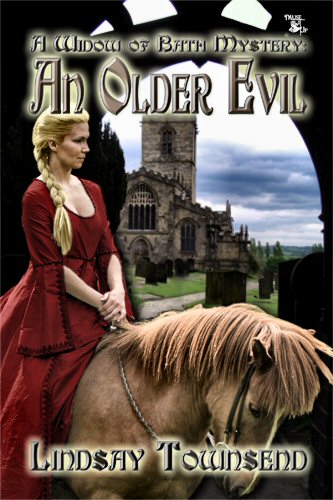
Return to Mystery - 'An Older Evil' by Lindsay Townsend

When I first started writing for publication, I wrote in one of my favourite genres, historical romance. Since then I have also written both romantic suspense and historical mystery, and the three genres have the following in common for me:

High stakes
Adventure
A ticking clock
A heroine under pressure who responds
A protective hero
A setting that has an impact on the characters.

With my most recent novel, I have returned to the Middle Ages and to Historical Mystery. An Older Evil - published now - is the first of a series of stories featuring the heroine Alyson Weaver. Alyson is older than my romance heroines and experienced in life and love, a widow of Bath who loves life and who hates injustice. In the times when she lived there was no formal police force, so when a stranger is murdered close to her home, Alyson feels compelled to investigate, especially when her family and household come under threat.

Alyson is also happy to play Cupid whenever she can and there is a romantic subplot in this novel... an unusual romantic subplot.


MuseItUp Publishing, September  7, 2012

Buy the ebook now:

MuseItUp
Amazon US
Amazon UK
All Romance Ebooks


Here is  an excerpt:

 April 25th, 1386.

Sweeping into her airy workshop, Alyson had no inkling of the murder she would witness outside Bath that morning. Head busy with accounts, forearms aching from her weaving, she ducked from her sunny, tidy buttery into the whitewashed old hall, bearing a huge red-glazed pitcher and cups. Slipping past her weaving frame under the big square window and the trestle loaded with carding boards and piles of freshly washed wool, she handed each of the maids who spun for her today a foaming beaker of ale.

Dropping their spindles onto the rush matting, all three set off for the open door. Clustered in the threshold, giggling and pointing with their tankards, Emily, Kate and Bela had time for nothing but the man working in the nearby meadow. “He’s an angel!” cried Bela, smacking her lips.

Laughing, Alyson filled two more cups and joined them at the back door. “That’ll be the new woodman Felise mentioned. Let’s welcome him, shall we? No, Bela.” She caught the youngest girl back. “I’d best go first. I need to warn your angel to keep to the path whilst he tends the abbey’s trees.” Threading between Kate and Emily, Alyson stepped down into the yard. “I’ll find out his name for you. You can take him bread and ale at noon. Just be sensible.”

Impossible advice. Aware of the excited whispering behind her, she struck out across the beaten earth yard, past the shadow of her new timbered hall, to where her plump laundress was doubled over a cauldron of hot water, scouring linen with a scrubbing board. After leaving the sweating Willelma her ale, Alyson dipped through the yard gate and trod amongst the damp meadow primroses, daisies, and fresh grass. Clambering the steep chalk track toward Beacon Hill, the spring sun warm on her strong, high-coloured face, she had a splendid view of the young man working in the ash copse at the far side of her small hillside meadow, his back to her as he sawed fallen branches.

Alyson stopped dead, her free hand making the sign of the cross. By the rood, he was like Jankin! Those crisp blond curls and long shapely legs made the woodman a mirror of her fifth and youngest husband. Jankin’s luminous eyes and teasing mouth had charmed her more than spiced wine, music, or dance. But Jankin was two years dead, murdered in a tavern brawl.

Suddenly, Alyson felt the weight of her forty-five years. She trembled, her breathing quickening, though not from the climb. Ahead, the woodman sawed on, the bite of metal on wood louder than the raucous twitter of nesting birds and the bawling of street vendors down below in nearby Bath. Waiting for her grief to subside, Alyson looked back, thinking of her home, lonely at the edge of meadows. She had fragile memories of running as a tiny child through that rectangular block of cramped kitchen, old hall, and little buttery, then up an outside stair to a small private chamber—Mother’s sun-room, called a solar.

Alyson sighed, conscious of a dropping chill in her belly although the day was bright. The old house fronted the road, its main windows and doors facing down into Bath. Her fourth husband, Peter, had demanded more privacy, and a second crook-gabled dwelling had been built on at right angles to the first, so now the house was an L-shaped block. Peter had approved the handsome brown and white cross-beamed timbered long hall. He had chosen the three lancet windows in the new hall with their top quatrefoils done in expensive glass—showy but cold. It had been Peter, too, who had determined where the hall dais should go and the hearth. Inside the house, there were many pieces of furniture and plate to be polished, for Peter had aspired to be a country worthy as well as a wool merchant.

Alyson was a city child. After the great pestilence of 1349 had carried off her parents from this country suburb, Alyson had been brought up inside Bath at her brother Adam’s house. Her daughter, Margery, and grandchild, Benedict, still lived within its lively streets. Her keen sight took in the small city, snug in its setting of limestone cliffs and wooded hills, the pale bulk of the abbey church and its grounds filling most of the city walls and dominating the narrow streets with their thatched houses and thermal baths, famous for cures throughout Christendom. Lucky Mag and Ben, to dwell so close to so much company and gossip! Yet Bath was where Peter’s long-term mistress lived, and Alyson would have walked farther than Jerusalem to avoid Isabel.

Catching a scent of cowslips on the breeze stirring the tips of her veil, she shaded her eyes. Beyond her field ran the London road, threading to the left past her church of St. Michael and into the north gate of the city. Where that road narrowed and became lined with tall, timber-framed houses, Felise Brewster lived, baker of the best date slices in Bath. She called in most days. Felise was sickly now and could no longer gad about. Recalling her friend’s listless limbs and stricken face, Alyson turned again, eager to be on her way.

The stranger must have heard the rustle of her skirts. Fast as a cleric’s angel dancing on a pinhead, he spun about, the saw raised like a club. Or a sword, ready to slash at an enemy, thought Alyson, hoisting her flagon. “Forgive me if I startled you. I’m your neighbour, Mistress Weaver. You’re working in my field.” Alyson blazed her engaging gap-toothed smile and held out the ale. “For you.”

The saw lowered, and a white hand removed the wooden beaker from her fingers. Crisp gold curls rolled forward as the young man nodded thanks, his dark eyes swarming over her shapely figure. He grinned, but Alyson was uneasy. Something was wrong here. “You’re here from the north?” she asked in Midlands speech.

No recognition. Alyson tried Cornish, Yorkshire, and Canterbury dialects, but the young man drank on with no more understanding than an ape. Pretty manners, though: when he’d finished he wiped his mouth with the back of his hand, not his sleeve. Such a patched, honest sleeve, thought Alyson. Tight round his arm, but with clothes being so often passed on in families, that wasn’t to be wondered at. His smooth new hose were a different matter.

“Your stockings are very fine,” she murmured in Latin.

The woodman glanced down the front of his short homespun tunic, and she seized the chance to walk on, leaving the flagon behind. Whatever was going on here, Felise was more important than this mystery.

* * * *

Trapped in her friend’s stifling back parlour before a spitting birch wood fire and nursing a goblet of mead, Alyson squirmed on the high-backed bench. Excessive heat always made her queasy, but Felise needed the warmth. “You are well today?” she asked, concerned.

“Not bad.” Felise stirred into her posset a spoonful of the herbs Alyson had brought. She tapped her goblet. “Thanks for these.”

Alyson dragged the vermilion veil off her head and raked hot fingers along one of her darkening blonde plaits. “It’s nothing.”

“You know that’s not true. Your mixtures always help, especially after the apothecary.”

Alyson scowled. “I trust you didn’t let him bleed you.” Felise, who was around the same age as her, was not strong and lost too much blood already through abnormal monthly courses.

“I told him no this time.”

Alyson looked up and saw the blush on her friend’s delicate oval face, the glint of fire in the wide black eyes. Delighted, she whistled at a pet finch chirruping in its wicker cage in one corner of the cosy room and squeezed the small hand lying on the bench next to hers. “Good!”

Starting to her feet, Alyson leaned round the yellow and blue striped wall hanging to peer through the half-opened shutters of the lancet window. “Your Gilbert must be pleased. Where is he this morning?”

Felise shrugged narrow shoulders. “Off somewhere as usual. Alyson, this strange young man you mentioned earlier—how did you guess it wasn’t the new woodman?”

“Because his clothes were wrong. The tunic he was wearing had been made for a shorter, leaner man, and it wasn’t a hand-me-down. Not with those fancy hose. And the abbey wouldn’t hire a forester round Bath who understood Latin but not a word of our dialect.” Alyson tutted. “This was a quick deception, for what reason I’ve no notion. The man’s a squire, still training in arms, or a clerk.” She nodded, long blonde and hazel plaits bobbing against her hips. “He didn’t come at me with that saw. Probably a clerk.”

“Like Jankin. Or your son, William, as he might have been,” Felise added.

“As you say.” Alyson slowly resumed her place on the wooden bench. Her eyes had begun to smart, maybe from the curling wisps of wood smoke.

The pet finch fell silent. In the small pause that followed, Alyson heard someone scream in the kitchen. A shower of crockery hit stone flags on the floor below theirs, and a pair of heels pounded off in the direction of the scullery. She started to her feet again, her tall figure protectively in front of Felise. “What’s happening?”

There were sounds of a scuffle, then a yell and a rush of savoury smells as the kitchen door slammed open and shut. A tumult of kitchen steam and bickering drifted up the steep staircase outside the parlour.

“What is it?” Alison asked.

“Oliver, raiding off the spits again.” Tiny Felise slumped on the bench, clutching a cushion. “Alyson, he’s dreadful! He was sent back to us last night. Gilbert had to pay the potter a fortune for his wicked damage.”

Alyson said nothing. Oliver would never have lasted as an apprentice potter. The boy was too full of energy to be penned indoors.

“What am I going to do with him?” Felise weakly pummelled her cushion. “He wrecks everything he touches! Gilbert complains he does nothing but stuff himself with food.”

“Ten-years-old is a starving time. I remember eating a whole loaf at the same age and being beaten for it.” Alyson set her empty goblet down into the hearth. “He’ll grow out of it.”

“Last night he set fire to his bedding!”

This was new, and worse, even for Oliver. Forcing an easy tone, Alyson remarked, “How many broken apprenticeships is it? Tailor, goldsmith, lantern-maker? He’s a bright child. Could you ask him what he wants to do?”

“We’re his parents. We know what’s best for our son.”

Glad to escape the fireside again, Alyson stepped over the sheepskin hearthrug and stalked to the casement, squinting through the shutters for the sight of a squat, barrel-chested, flame-haired boy, the youngest of Felise’s brood of nine and the quickest in legs and wit. She felt pity and sadness for her friend and sympathy for Oliver, having been a tearaway herself.

“Why not send the young scamp to me? I’ll make him my page. He can sweat over sheep shearing, use up some of that fire.” Gilbert might condemn her as a bad influence, but at Alyson’s house, Oliver would be settled close to his mother’s, and Alyson would allow him to visit home often.

Poor, blind Gilbert, for not seeing how his youngest cared! Nor noticing how Oliver blamed himself for his mother’s shattered health, being clever enough to know how much Felise had been worn down by childbirth.

Smarting at life’s injustice, Alyson banged open a shutter and hollered down at the seemingly deserted herb garden, “I see you, Oliver, lounging by the lavender. You come out of there before you trample everything!”

A stifled sigh from the bench had her turning swiftly to kneel by her friend. “Sorry, Felise, that was ill-mannered! I forget myself. It’s the influence of Mars: it makes me too impetuous.”

Felise clasped the pleading hands. “Alyson, dear, I would not have you different. As for my boy—” Her fine black eyes swelled with tears.

Alyson leaned closer. “What is it? Not Oliver; you know he’s a good lad.”

The dry hands tightened their grip. “Alyson…has Gilbert a mistress?”

“Never! He dotes on you.”

“He’s going on pilgrimage. To the new shrine of the Virgin at Walsingham. He’s never wanted to go before, and I’m too feeble to accompany him.”

“So you assume he’s taking along a substitute wife? On a holy journey?”

“I know what happens between men and women on pilgrimages. You told me!” Felise released her friend and took up the posset again. “Alyson, could you go along? You love to travel, and you’ve never been to Walsingham. You could keep an eye on Gilbert for me.” She coughed dryly, clutching her chest, but smiling all the same. “You might even find yourself another husband!”

Alyson could still not believe it. “Tell me why you believe Gilbert’s unfaithful. Spare me no details!” The mystery of the false woodman she dismissed completely from her mind.

* * * *

The angelus was ringing all over Bath when Alyson left the smoky thatched house in Walcot Street. Nothing had been settled; not Oliver’s present place, nor Gilbert’s possible infidelity. Felise had certain pointers. Gilbert bathing regularly in the healing spring of the King’s Bath while not complaining of being ill. Gilbert bringing home a mirror one day and keeping it for his own use. Yet he showed no lessening in affection to his wife, so Alyson smiled comfortingly and said Felise must be mistaken.

But Felise had begged again for Alyson to go to Walsingham. A group of pilgrims were due to set out from Bath in five days’ time, Gilbert included, and Alyson promised to consider joining them.

Relieved to be out of doors after the baking heat of an invalid’s chamber, she strode out, swinging her aching arms, head up as she attacked the steeply rising path through the meadow. She wanted to be home before St. Michael’s noon bell sounded, and Bela hustled her more timid companions up the hill with the stranger’s food. A man in disguise might not be a threat to her girls, but it was best she be wary.

Ahead of her the squire-forester sawed slowly, clearly unused to the work. Puzzling again as to why he was doing it, Alyson called out, “Good morning!”

He stopped sawing, turned, and stared through her, not at her. He shouted something, words drowned by the noon bell, and Alyson jerked her head round, wondering what he had seen.

There was nothing below her but the nodding yellow cowslips of the meadow, the gate into Felise’s garden, and beyond that, the ochre dust of the London road and shimmer of distant houses. Disappointed, Alyson turned again, wondering what might have startled the youth into breaking his silence.

She saw him stagger and fall, try to crawl toward her, then slump face down into the grass. Alyson shouted and ran to him, but she was already too late. The sleek young body, curled over as though in sleep, was still and breathless, the golden curls dimmed by dust and blood. The stone that had shattered his skull had smashed open his right eye; he was beautiful no longer. He was dead.

Lindsay
http://www.lindsaytownsend.net
http://www.twitter.com/lindsayromantic

Sunday, 19 August 2012

1789 Prelude to Britain's Long Struggle Against France

1789. Prelude to Britain’s struggle against France.

Baroness Orczy’s Scarlet Pimpernel is the fictional hero, Sir Percy Blakeney Bart, who saved the victims of the French Revolution. Unfortunately, when it began there was no real life hero to save de Launey, Governor of the Bastille.

On the 14th July, 1789 the French revolution began. A violent crowd of men and women gathered in front of the Bastille. Shortly before five o’clock the rabble stormed the old Paris fortress and tore de Launey, 30 Swiss guards and 80 pensioners to pieces. Afterwards, holding severed heads aloft, they set out to murder the chief magistrate in the Hotel-de-Ville.

This event announced to the world that the French intended to overthrow the old order.

The foundation of society had been the feudal system. By 1789 taxation had impoverished the French workers living in abject misery in hovels.The people demanded change.Writers and philosophers extolled the virtues of a longed for age of reason.

During the reign of Louis XIV France was the most powerful nation in Europe. If William III of England and Marlborough had not defeated France, the French might have ruled Europe. Yet, in France, effective government was eroded by the aristocrats’ privileges, the middle classes exclusion from government and ever increasing dissatisfaction with the Church. The governing class lost touch with the masses, who, in 1788 and 1789 suffered from hunger and cold.

In January 1789, the treasury was bankrupt, the last harvest had been ruined, and the streets of Paris were flooded with unfortunate wretches.  After two centuries of absolute rule the king summoned the States General to meet at Versailles. After three weeks, the Third Estate took control. This declaration was a prelude to the storming of the Bastille and, eventually, Britain’s 22 year struggle against France.

Sunday, 12 August 2012

Britain's 22 year-long Struggle Against France

When I think of the French Revolution, the reign of George III and Regency, so many authors spring to mind. Dickens, Thackery, Jane Austin, Georgette Heyer, Bernard Cornwell’s Sharpe, and many others.

At the moment I am studying the late 18th century and the early 19th century.

For twenty-two years, from 1793 to 1815, France tried to dominate the world. At the beginning of this period, some men and women who had seen the Protector Richard Cromwell were still alive. At the end of it those who would live until Adolf Hitler was young had been born. On a personal note my grandfather remembered my long-lived great grandfather speaking about the Battle of Waterloo.

During those years of struggle the French wanted to overturn the old order, however the British did not accept a government not based on the rule of law. At one time Britain fought nearly the whole of Europe with little hope of victory. To make matters worse, when Britain was on the verge of bankruptcy, revolutionary France benefitted from Napoleon Bonaparte, considered by many to be the greatest military genius in the history of the world.

Until Sir John Moore fought Napoleon in Spain, only the Russians triumphed over Napoleon for a few months between 1806 and 1807.  

Trafalgar and the battle of Waterloo are so well-known that the first ten years of struggle, which William Pitt called ‘the virtues of adversity endured and adversity resisted, of adversity encountered and adversity surmounted, which ended in the Peace of Amiens, are often forgotten.

The peace did not last but it did give Britain the breathing space necessary for the war to continue until 1815.

Available from https;//museituppublishing.com/bookstore2, Amazon kindle,Good Reads, Kobo and elsewhere

Sunday's Child a Regency Novel. Despite quixotic Major Tarrant's experience of brutality, honour,loss and past love, experience of brutality will it be possible for him to find happiness?
Tangled Love set in England in 1706. The tale of two great estates and their owners, duty, betrayal, despair and hope.
New Release. 27th October. False Pretences a Regency Novel. Will Annabelle escape an arranged marriage and discover who her parents are?


Sunday, 10 June 2012

Pre-order Special Offer Sunday's Child Regency Novel by Rosemary Morris

Sunday’s Child – Announcement

I am proud to announce that my novel Sunday’s Child set in the Regency era will be published on the 15th of June by MuseItUp publishing, and that there is a pre-publication discount of 22%.

The idea for Sunday’s Child came while I read about modern day soldiers suffering from post traumatic syndrome, and the effect on the families of those who lost a soldier in war.  

What, I asked myself, would be the effect on Sunday’s Child whose beloved father and brothers died while fighting against the French in the Napoleonic Wars, and on a brave major who underwent a horrific experience, in the days when there was no counselling for post traumatic syndrome? How would they overcome their experiences?


Sunday’s Child
Prologue
Hertfordshire, England
1810

Fourteen year old, Georgianne Whitley leaned over the banister to watch her aunt’s butler admit a handsome cavalry officer dressed in uniform. One day, her mamma frequently assured her, she would marry such a military man, a member of her dear father’s regiment. Of course, this officer was probably too old to ever be her husband. However, in future, she was sure she would meet someone equally handsome with whom she would fall in love. She giggled. ‘Love is not the main prerequisite for marriage,’ Mamma always claimed. According to her mother, rank, lands, and wealth were more important whereas, according to Papa, love was the only reason to marry.
She turned her head to look at her cousin, Sarah Tarrant. “Who is he?”
“Don’t you recognize him? He is my half brother, Rupert, Lieutenant Tarrant.”
“Of course, but he has changed so much since I last saw him five years ago. He is taller.
Careless of whether or not he would look up and see her, Georgianne inched forward until, bent almost double, she could still gaze down at him.
Rupert removed his shako, revealing his thick, sun-kissed fair hair. 
Sarah put her arms around Georgianne’s waist. “If you are not careful, you will fall.”
Georgianne gripped the rail of the highly polished oak banister while she straightened.
“Look at your gown. It’s crushed. You’re such a…a hoyden.”
She stamped her foot. “No, I’m not.” 
“Yes, you are. My mamma says you are.”
“Well, she is wrong.” In spite of her denial, rueful, she looked down at her crumpled, white muslin gown. What would her aunt say if she knew Papa had taught her to shoot? Once again, she peered over the banister. A ray of June sunshine from the window illuminated the gold braid on Rupert’s scarlet uniform. Yes, one day she really would marry such an officer to please herself, and her parents. 

Chapter One
Hertfordshire, England
November 1813

             Rupert, Major Tarrant, caught his breath at the sight of seventeen year old Georgianne.  Black curls gleamed and rioted over the edges of her bandeau. Georgianne’s heart-shaped face tilted down toward her embroidery frame. Her hands lay idle on her gown. It was lilac, one of the colours of half-mourning. A sympathetic sigh escaped him. She wore the colour out of respect for her father, who lost a hand and leg, during the Battle of Salamanca, and died of gangrene more than a year ago.
        There had been so many deaths since he last saw Georgianne. Not only had her  brothers died during the storming of Ciudad Rodrigo but his elder brother had drowned six months ago while bathing in the lake on their father’s estate. 
        He advanced into the room with Adrian, Viscount Langley, at his side. Georgianne looked up and smiled. He caught himself staring into her hyacinth blue eyes, fringed with long black lashes. Colour crept over her high cheekbones. Her arched eyebrows drew together across her smooth forehead. Egad, she had the sweetest countenance he had ever seen; one with the lustrous, milky white sheen of china, and bow shaped rose pink lips to catch at the heart.
        Georgianne stood. 
        He bowed. “My condolences.”
        Sarah, clad in full mourning for her older half-brother, stood to make her curtsy to Langley. “I trust you have everything you require, my lord?”
        Langley bowed. “Yes, thank you.”
        “My lord, allow me to introduce you to my cousin, Miss Whitley.”
        Georgianne curtsied as his lordship crossed the parlour to make his bow. 
        Tarrant inclined his head. “Ladies, please excuse us, we must see to our horses.”
        Sarah shook her head at him. “See to your horses? The grooms can do so.”
        Georgianne gurgled with laughter. “Ah, Sarah, have you forgotten how cavalrymen fuss over their mounts?”
        “Excuse us.”
****

        After the gentlemen left, Georgianne glanced at her cousin. She had seen little of her since Sarah yielded to the family’s persuasion to marry Wilfred Stanton, heir to his uncle, the Earl of Pennington. 
        Despite her reluctance to leave home because of her mamma’s unfortunate habit, and extravagant displays of grief over the loss of her husband and sons, Georgianne agreed to visit her cousin Sarah, who suffered from melancholy after the birth of a son. 
        Anxious for her mamma and two younger sisters, she reminded herself Whitley Manor—on the southern outskirts of Cousin Stanton’s Hertfordshire parish—lay a mere fifteen minutes away by carriage.
        “Are you daydreaming, Cousin?”
        Georgianne pretended to be busy untangling another strand of embroidery thread. “No.”
         “Did I tell you Papa wants Tarrant to resign from the army now he is Papa’s heir?” Sarah’s needle flashed in and out of her work.    
        “Yes, several times.” Georgianne shivered, stretched her hands toward the fire, and fought a losing battle with the draughts in the old vicarage.
        “Are you not interested in dear Tarrant?”
        Georgianne bent her head. Once, she had wanted to marry a military man. However, after the loss of her father and brothers, she changed her mind for fear death might snatch him from her, either on the battlefield or as a result of wounds sustained in combat. She shook her head, remembering the dreams she harboured three years earlier when she last saw Major Tarrant. How her life had altered since then. Most of the time, she lived cloistered at home in reduced—yet not impoverished—circumstances. She spent her life in an endless round of mending and embroidery, both of which she detested. Her only escape from this drab existence consisted of daily walks, rides, or reading her beloved books. A yawn escaped her. Oh, the tedium of her days at home.
        “You have not answered my question.”
        Georgianne gathered her thoughts. “Yes, Sarah, I am interested in Major Tarrant. After all, we have known each other since we were in the nursery.”
        “Good, but what are you thinking about? You are neglecting your sewing.”
        Georgianne picked up her needle and thrust it in and out of the chemise, careless of the size of her stitches. Already she loathed the garment and vowed never to wear it.
        “Papa wants Tarrant to marry,” Sarah rattled on.
        Eyes downcast, Georgianne set aside her sewing and wrapped her arms around her waist for comfort. Before they died, her brothers and father had expressed their admiration for Major Tarrant in their letters. She shrugged. Once upon a time, she had built a castle in the air inhabited by Major Tarrant, a mere lieutenant when she last saw him.
        Mamma still insisted on love not being the prime consideration for marriage, but novels and poems contradicted her opinion. Georgianne wanted to fall in love with one of the many eligible young gentlemen available: maybe a titled gentleman like Viscount Langley, provided he was not a military man. She shrugged. Certainly her mamma would regard the Viscount favourably. His lordship was wealthy, possessed good manners, and his height and broad shoulders equalled Major Tarrant’s. However, although she found no fault with him, Mamma might not approve of the Viscount’s skin—almost as dark as a gypsy from exposure to the sun while serving abroad—and his hair and eyes, sufficiently dark to rival any Spaniard’s. Her spirits lifted. The rectory would be a happier place with two fine young men in attendance. She was glad to be here, despite her acute concern for her family.
                 Sarah’s voice ended her musing. “Have you heard Tarrant inherited his godfather’s estate and fortune? Besides his pay, his income is thirty thousand pounds a year.”
        Georgianne nodded. “Yes, I know. Major Tarrant is exceptionally fortunate.” Sarah blinked. “Why are you smiling?”
        Georgianne stood and crossed the room to look out of the window. “I am happy because, so far, Major Tarrant and Viscount Langley have survived the war, which has taken so many lives and affected everyone in some way or another.” 
        She must force herself to remain cheerful. Papa had died eighteen months ago. It was time to set grief aside, if she could only find the means.
        Thankfully, there was much to look forward to. After her presentation at court, she would be sure to meet many engaging gentlemen, one of whom she might marry. In time, she could help her sisters to escape their miserable existence.
        Georgianne drummed her fingers on the windowsill. Her thoughts darted hither and thither. She glanced around the parlour, inhaling the odour of potpourri and lavender-scented beeswax. 
        Wilfred Stanton entered the room. He stood with his back to the fire, hands clasped over his paunch. “Mrs Stanton, my uncle, the Earl of Pennington, has arrived unexpectedly, and  is resting after the rigours of his journey. Tarrant and his friend are busy with their horses. No, no, do not disturb yourself, my love. No need to bestir yourself on my uncle’s behalf.”
        Cousin Stanton’s lips parted in a smile revealing yellowed teeth. “Ah, I know what you ladies are like. Have you been matchmaking? There must be a dozen or more eligible members of the fair sex amongst our neighbours who would be eager to meet Tarrant. If they knew of his visit, I daresay all of them would harbour thoughts of marrying him.”
        “Indeed,” Sarah said in a colourless tone of voice.
        Accustomed to taking long walks every day, Georgianne fidgeted. She found it difficult to tolerate Sarah’s sedentary habits. 
         “Sarah, will you not come for a walk? You know the doctor is concerned by your continued lethargy. Do not forget he encourages gentle exercise to improve your health.” She stared out at the dark grey clouds. Suddenly they parted and sunlight bathed her. It heightened the colour of her gown and warmed her. She reached up to smooth her bodice and noticed a movement in the shadowed east wing. Was someone peering at her through the small, diamond-shaped panes? There were no menservants in the household. Could it be Cousin Stanton’s uncle, the earl?
        Sarah stepped daintily to her side, and slipped an arm around her waist. “Come, it is time to change our clothes before we dine.”